From: Pascal Van Cauwenberghe <pvc@nayima.be>
Date: July 11, 2007 7:27:09 AM CDT
To: submission@rubyquiz.com
Subject: Please Forward: Ruby Quiz SubmissionHi James,
I don't subscribe to ruby-talk, too much volume. Could you forward my submission for the Hangman puzzle? Thanks.
The program doesn't concern itself with UI or gameplay, but more with strategies. The tests need a word file to run correctly. This is available online (see URL in the code).
Thanks for organizing the Ruby Quiz. This is the first time I send in a solution, but I've implemented several of them before. It's a great way to keep up the coding muscles.
--
Pascal Van Cauwenberghe
Nayima bvba
---
http://www.nayima.be
http://www.xpday.net
http://www.xp.be
require 'rubygems'
gem 'rspec'
require 'spec'# The HangMan classes don't bother with UI. I was more interested in the strategies that could be used
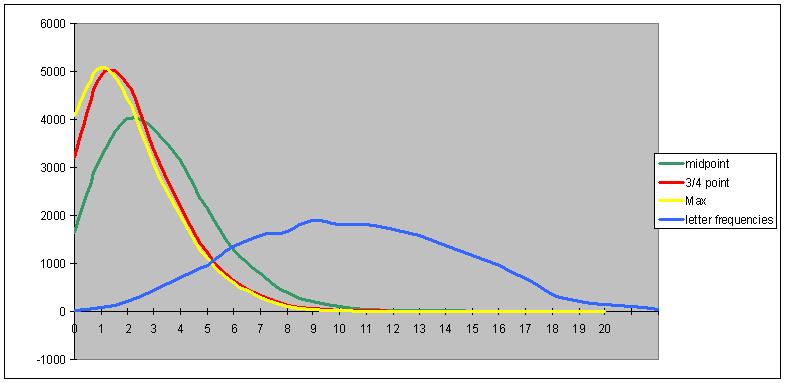
# The experiment consists of playing the game on +/- 20900 English words of 5 letters or more and
# plotting how many wrong guesses are made. The player has the dictionary.# The first strategy I thought of was a classic 'Binary chop': find the letter that appears in about half
# of the words. Thereby, you eliminate half of the words from the dictionary, whatever the outcome.
# This strategy succeeds in guessing the right word with 5 or fewer wrong guesses in 86% of cases
# This is implemented in MidpointStrategy
#
# But this is not a symmetrical problem: we're not optimizing the number of guesses, but the number of wrong guesses.
# Also, a correct guess gives us more information than a wrong guess: we get the position(s) of the correct letter.
# This allows us to eliminate even more words.
# The ThreeQuarterpointStrategy chooses the letter that is present in about 3/4 of the words.
# This strategy succeeds in 94 % of cases.
#
# The MostFrequentStrategy chooses the letter that appears in most words. This strategy succeeds in almost 95% of cases.
#
# The EnglishFrequencyStrategy is much simpler: it doesn't take advantage of the dictionary. It just guesses letters
# based on their frequency in English words. This strategy is faster than the others but does poorly: 11% success
#
# The results can be seen at http://blog.nayima.be/wp-content/uploads/hangman-strategies.JPG# The code is mostly self-explanatory. I've had to cache a few things (letters in Words, the number of words that contain a letter)
# to speed things up. The simulation plays about 1100 games per minute
#
# The tests use a file words.txt that I copied from /usr/share/dict/words
# Each line of the file contains one word
# This file can be downloaded from http://blog.nayima.be/wp-content/uploads/words.txtmodule RubyQuiz
# A Word describes a word in the dictionary
# For optimization, the word keeps an array of all unique letters in the word
class Word
attr_reader :word
attr_reader :letters# Create a word with the given string
def initialize(word)
@word = word
@letters = unique_letters_in(word)
endprivate
def unique_letters_in(word)
bytes =
word.each_byte {|c| bytes << c }
bytes.uniq
end
end# The Dictionary contains a list of words
class Dictionary# Create an empty dictionary
def initialize
change_wordlist
@dictionary_per_size = {}
end# Add one word to the dictionary
def add(word)
change_wordlist(@words + [ Word.new(word) ] )
end# Load all words from a text file (one word per line)
# Keep only words that are 5 ascii letters or more
# Words all all lower case
def load(file)
words = File.readlines(file)
words = words.collect {|word| Word.new(word.chomp.downcase) }
change_wordlist(words.select {|word| word.word.length >= 5 && word.word =~ /^([a-z])+$/ })
self
enddef dup
other = super
other.add_words(@words)
other
end# Return a new Dictionary with only the words of the given length
def with_only_words_of_size(len)
other = Dictionary.new
@dictionary_per_size[len] ||= @words.select{|word| word.word.length == len }
words = @dictionary_per_size[len]
other.add_words(words)
other
end# Number of Words
def length
@words.length
end# Access each Word individually
def (index)
@words[index].word
end# Filter out all words that don't have the given length
def keep_only_words_of_length(len)
change_wordlist(@words.select{|word,letters| word.word.length == len })
end# Filter out all words that contain the given letter
def reject_words_that_contain(letter)
change_wordlist(@words.select { |word,letters| word.word.index(letter) == nil })
end# Keep only the words that match the partial solution
def keep_only_words_that_match(hangman_pattern)
pattern = Regexp.new('^' + hangman_pattern.gsub(/-/,'.') + '$')change_wordlist(@words.select { |word,letters| word.word =~ pattern })
end# Return the number of words in the dictionary that contain the given letter
def words_that_contain(letter)
letter_count(letter)
end# Iterate over each Word
def each(&block)
@words.each(&block)
endprotected
def add_words(words)
change_wordlist(words)
endprivate
def change_wordlist(list)
@words = list
@letter_counts = nil
@dictionary_per_size = {}
end# Compute the number of words that a letter appears in
# Because this is an expensive operation, cache the results. The cache is invalidated when the list of Words changes
def letter_count(letter)
@letter_counts ||= compute_counts
@letter_counts[letter[0] - ?a]
enddef compute_counts
count = Array.new(26,0)
@words.each do |word|
word.letters.each {|c| count[c-?a] += 1}
end
count
end
end# Guess the letter that appears in most words
class MostFrequentStrategy
def score_for(letter,dictionary)
dictionary.length - dictionary.words_that_contain(letter)
end
end# Guess the letter that appears in approx half of the words
# If there's only one word left, use the letters in that word first
class MidpointStrategy
def score_for(letter,dictionary)
if dictionary.length >= 2 then
midpoint = dictionary.length / 2
nbwords = dictionary.words_that_contain(letter)
midpoint > nbwords ? midpoint - nbwords : nbwords - midpoint
else
dictionary.length - dictionary.words_that_contain(letter)
end
end
end# Guess the letter that appears in approx 3/4 of the words
class ThreeQuaterpointStrategy
def score_for(letter,dictionary)
if dictionary.length >= 2 then
midpoint = 3 * dictionary.length / 4
nbwords = dictionary.words_that_contain(letter)
midpoint > nbwords ? midpoint - nbwords : nbwords - midpoint
else
dictionary.length - dictionary.words_that_contain(letter)
end
end
end# Guess the letter that appears in most words, using the frequency of letters in English words
# Doesn't take the dictionary into account
class EnglishFrequencyStrategy
def score_for(letter,dictionary)
frequencies = "earitnoslcumdphbgyfvkwxqjz"
frequencies.index(letter)
end
end# The HangMan solving class
# Play is simple:
# - Give the solver a puzzle to solve as a string of '-', a dictionary and optionally a stratagy for choosing the next letter
# - Ask the solver for a guess
# - Tell the solver it took a wrong guess: the letter doesn't appear in the solution
# - Or tell the solver it took a good guess. Give it a string with '-' replaced with the good letter
# - Keep on going until the puzzle is solved
class HangManSolver
# The current solution
attr_reader :solution# Create a HangMan Solver
# puzzle should be a string of '-' as long as the word to guess
# dictionary is a Dictionary. The solver can find words that are not in the dictionary
# strategy is an optional parameter to determine the letter choosing strategy
# a Strategy object should implement one method score_for(letter,dictionary) => numeric score
# the lowest scoring letter is chosen
def initialize(puzzle,dictionary,strategy=MostFrequentStrategy.new)
@solution = puzzle.dup
@dictionary = dictionary.with_only_words_of_size(puzzle.length)
@possible_letters = ('a'..'z').to_a
@strategy = strategy
enddef merge(answer)
for pos in 0..@solution.length
if @solution[pos] == ?- && answer[pos] != ?- then
@solution[pos] = answer[pos]
end
end
@solution
end# Returns true if the solution is known
def solved?
@solution !~ /-/
end# How many more Words in the dictionary are candidates?
def possibilities
@dictionary.length
end# Returns the letter that the solver guesses
# Uses the strategy to determine the letter with the lowest score
def guess
letters = @possible_letters.collect {|letter| [ score_for(letter),letter ]}
letter = letters.min {|letter1,letter2| letter1 <=> letter2 }
letter[1]
end# Tell the solver that the letter does not appear in the solution
def wrong_guess(letter)
@possible_letters.delete(letter)
@dictionary.reject_words_that_contain(letter)
end# Tell the solver that the letter was a good guess, by placing the letter in the solution
# e.g. to indicate that 'a' is a good guess for 'hangman' pass '-a---a-'
def good_guess(pattern)
merge(pattern)
@dictionary.keep_only_words_that_match(@solution)
@possible_letters.delete(letter_in(pattern))
endprivate
def score_for(letter)
@strategy.score_for(letter,@dictionary)
enddef letter_in(pattern)
result = ' '
pattern.each_byte {|char| result[0] = char if char != ?-}
result
end
end# The HangManPlayer can tell if the Solver made a good/wrong guess
class HangManPlayer
def initialize(word)
@solution = word.dup
enddef evaluate(letter)
template = ''
@solution.each_byte do |char|
template << (char == letter[0] ? char : ?-)
end
template
end
end# The Game uses the Solver and Player to find a word, given a dictionary and a strategy
class HangManGame# Finds the given word, using the dictionary and the strategy
# Returns:
# the word found
# the number of wrong guesses
# an array of guesses. Each item is a '+' (good guess) or '-' (wrong guess) and the letter guessed
def self.solve(word,dictionary,strategy=MostFrequentStrategy.new)
guesses =
empty = '-' * word.length
player = HangManPlayer.new(word)
puzzle = HangManSolver.new(empty ,dictionary,strategy)
wrong_guesses = 0
while !puzzle.solved? do
letter = puzzle.guess
pattern = player.evaluate(letter)
if pattern == empty then
puzzle.wrong_guess(letter)
wrong_guesses += 1
guesses << "-#{letter}"
else
puzzle.good_guess(pattern)
guesses << "+#{letter}"
end
endreturn puzzle.solution,wrong_guesses,guesses
end
enddescribe Word do
it "should identify its unique letters" do
word = Word.new('banana')
word.letters.length.should eql(3)
word.letters.should include(?b)
word.letters.should include(?a)
word.letters.should include(?n)
end
enddescribe Dictionary do
it "should contain words" do
dict = Dictionary.newdict.add("hangman")
dict.add("packman")
dict.add("rackham")dict.length.should == 3
endit "should select only words of a certain size" do
dict = Dictionary.newdict.add("hangman")
dict.add("packman")
dict.add("rackham")
dict.add("rat")
dict.add("hang")dict.keep_only_words_of_length(7)
dict.length.should ==(3)
endit "should load word files" do
dict = Dictionary.new
dict.load("words.txt")
dict.length.should eql(20905)
dict.keep_only_words_of_length(7)
dict.length.should eql(3872)
endit "should select words that match pattern" do
dict = Dictionary.new
dict.load("words.txt")
dict.length.should eql(20905)
dict.keep_only_words_that_match('h------')
dict.length.should eql(155)
dict.keep_only_words_that_match('ha---a-')
dict.length.should eql(11)
endit "should throw away words that contain a wrong letter" do
dict = Dictionary.new
dict.load("words.txt")
dict.length.should eql(20905)
dict.reject_words_that_contain('z')
dict.length.should eql(20605)
dict.reject_words_that_contain('x')
dict.length.should == 20075
endit "should know how many words contain a certain letter" do
dict = Dictionary.new
dict.load("words.txt")
dict.length.should eql(20905)dict.words_that_contain('e').should eql(13211)
dict.words_that_contain('f').should eql(1915)
dict.words_that_contain('z').should eql(300)
dict.words_that_contain('r').should eql(10403)
end
enddescribe HangManPlayer do
it "should evaluate guesses" do
player = HangManPlayer.new("hangman")player.evaluate('a').should eql('-a---a-')
player.evaluate('b').should eql('-------')
player.evaluate('m').should eql('----m--')
endend
describe HangManSolver do
it "should accept a puzzle" do
puzzle = HangManSolver.new("-------",Dictionary.new)
endit "should merge solutions and answers" do
puzzle = HangManSolver.new("-------",Dictionary.new)
puzzle.solution.should eql("-------")
puzzle.merge("-a---a-")
puzzle.solution.should eql("-a---a-")
puzzle.merge("----m--")
puzzle.solution.should eql("-a--ma-")
endit "should know when it's solved" do
puzzle = HangManSolver.new("-------",Dictionary.new)
puzzle.solved?.should be_falsepuzzle.merge('h------')
puzzle.solved?.should be_falsepuzzle.merge('-angman')
puzzle.solved?.should be_true
endit "should find 'hangman'" do
puzzle = HangManSolver.new("-------",Dictionary.new.load("words.txt"))
puzzle.possibilities.should eql(3872)
puzzle.guess.should eql('e')
puzzle.wrong_guess('e')
puzzle.possibilities.should eql(1490)
puzzle.guess.should eql('a')
puzzle.good_guess('-a---a-')
puzzle.possibilities.should eql(69)
puzzle.guess.should eql('r')
puzzle.wrong_guess('r')
puzzle.possibilities.should eql(37)
puzzle.guess.should eql('n')
puzzle.good_guess('--n---n')
puzzle.possibilities.should eql(2)
puzzle.guess.should eql('m')
puzzle.good_guess('----m--')
puzzle.possibilities.should eql(2)
puzzle.guess.should eql('d')
puzzle.wrong_guess('d')
puzzle.possibilities.should eql(1)
puzzle.guess.should eql('g')
puzzle.good_guess('---g---')
puzzle.possibilities.should eql(1)
puzzle.guess.should eql('h')
puzzle.good_guess('h------')
puzzle.possibilities.should eql(1)
puzzle.solution.should eql('hangman')
end
enddescribe HangManGame do
it "should find words in the dictionary" do
dictionary = Dictionary.new
dictionary.load("words.txt")
solution, round = HangManGame.solve('hockey',dictionary)solution.should eql('hockey')
endit "should find words not in the dictionary" do
dictionary = Dictionary.new
dictionary.add('hockey')
dictionary.add('cyclic')
solution, round = HangManGame.solve('pascal',dictionary)solution.should eql('pascal')
endit "should find all words in the dictionary" do
# result[i] contains the number of words that made i wrong guesses
result = Array.new(26,0)dictionary = Dictionary.new
dictionary.load("words.txt")# Change the strategy to test another type of strategy
strategy = MostFrequentStrategy.new
dictionary.each do |word|
solution,wrong_guesses,guesses = HangManGame.solve(word.word,dictionary,strategy)
solution.should eql(word.word)
result[wrong_guesses] += 1
end
# Uncomment to print out the number of words per number of wrong guesses
# puts "=> #{result.inspect}"
endend
end
···
Begin forwarded message: