Playing with how to integrate modules, classes, subclasses, and create
instance methods and class methods from modules.
In this play code below, I want to use initialize_colors in either the
class Shape or Square as a class method.
At this point I'm sure I'm missing a very simple syntax rule explained
very clearly in the books, but the code as is complains about
initialize_colors as being undefined, and I'm just not recognizing what
I am missing.
module Color
def initialize_colors @fill_color = 'ffffff' @border_color = '000000'
end
def set_fill_rgb(color)
if color == 'white' @fill_color = 'ffffff'
elsif color == 'red' @fill_color = 'ff0000'
elsif color == 'blue' @fill_color = '0000ff'
elsif color == 'black' @fill_color = '000000'
end
end
end
class Shape
include Color
attr_reader :fill_color, :border_color
def initialize @fill_color = String.new @border_color = String.new
end
end
Well the methods you can call *as* a class is being defined are
*class* methods. initialize_colors is an instance method, as it
should be since it's setting instance variables.
It seems to me that you want to call initialize_colors not as the
class is being defined but as instances are being created. And
therefore the call to initialize_colors should be inside Square's
initialize method.
Eric
···
====
Are you interested in on-site Ruby training that's been highly
reviewed by former students? http://LearnRuby.com
On Nov 22, 12:58 pm, Greg Willits <li...@gregwillits.ws> wrote:
Can't see the tree for the forest.
Playing with how to integrate modules, classes, subclasses, and create
instance methods and class methods from modules.
In this play code below, I want to use initialize_colors in either the
class Shape or Square as a class method.
At this point I'm sure I'm missing a very simple syntax rule explained
very clearly in the books, but the code as is complains about
initialize_colors as being undefined, and I'm just not recognizing what
I am missing.
module Color
def initialize_colors @fill_color = 'ffffff' @border_color = '000000'
end
def set_fill_rgb(color)
if color == 'white' @fill_color = 'ffffff'
elsif color == 'red' @fill_color = 'ff0000'
elsif color == 'blue' @fill_color = '0000ff'
elsif color == 'black' @fill_color = '000000'
end
end
end
class Shape
include Color
attr_reader :fill_color, :border_color
def initialize @fill_color = String.new @border_color = String.new
end
end
In this play code below, I want to use initialize_colors in either the
class Shape or Square as a class method.
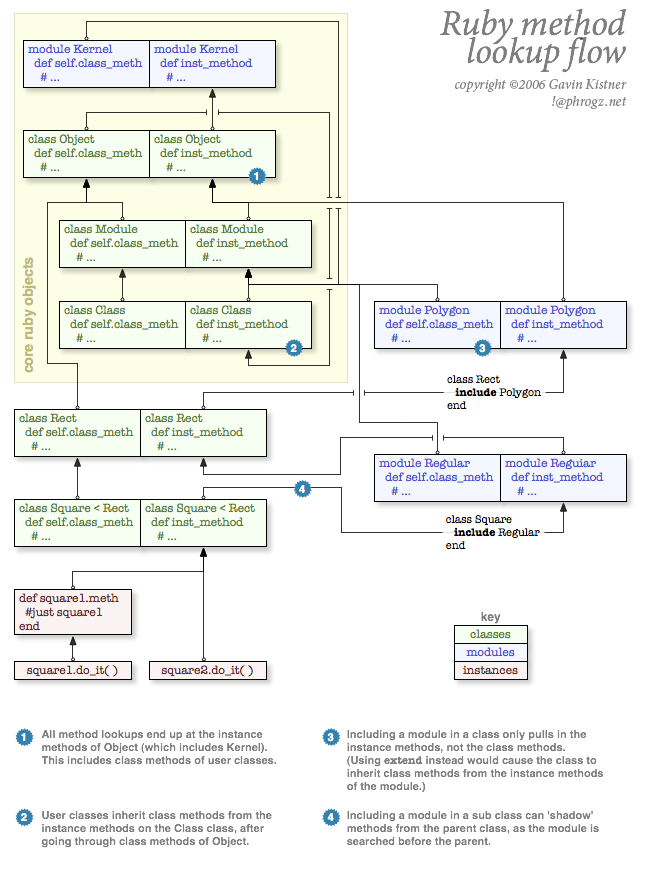
Including a module in a class causes instance methods of the module to
be in the lookup path for instances of the class. Extending a class
using a module causes instance methods of the module to be in the
lookup path for the class itself.
Well the methods you can call *as* a class is being defined are
*class* methods. initialize_colors is an instance method, as it
should be since it's setting instance variables.
It seems to me that you want to call initialize_colors not as the
class is being defined but as instances are being created. And
therefore the call to initialize_colors should be inside Square's
initialize method.
The exercise is to figure how to make initialize_colors work as a class
method -- so if the instance vars are misleading, then it's those I
would change.
I am just experiementing to understand with working examples how various
syntax and behavior are related in Ruby to acheive various levels of
functionality at the class, instance, and module realms.
Another way to look at this is that I'm trying to understand how some
things in Rails work by replicating them on a micro scale -- in this
case a good example might be how the validates_ methods all work.
They're called as class methods from within a subclass and I would
expect they're implemented via modules. I've traced the source, but
there's too much noise for me at this stage of my Ruby experience.
In this play code below, I want to use initialize_colors in either the
class Shape or Square as a class method.
Including a module in a class causes instance methods of the module to
be in the lookup path for instances of the class. Extending a class
using a module causes instance methods of the module to be in the
lookup path for the class itself.
A common idiom to be able to cause a class to get both class and
instance methods when including a single module follows:
Cool, thanks. But...
In this code the fill_color is still never set to black. It seems to me
that Module code even if added as class methods cannot access class
variables??
-- gw
module Color
module ClassMethods
def initialize_colors
@@fill_color = 'black'
p "woot!"
end
end
def self.included(receiver)
receiver.extend ClassMethods
end
end
class Shape
include Color
@@fill_color = 'white'
initialize_colors
In this play code below, I want to use initialize_colors in either the
class Shape or Square as a class method.
Including a module in a class causes instance methods of the module to
be in the lookup path for instances of the class. Extending a class
using a module causes instance methods of the module to be in the
lookup path for the class itself.
A common idiom to be able to cause a class to get both class and
instance methods when including a single module follows:
Cool, thanks. But...
In this code the fill_color is still never set to black. It seems to me
that Module code even if added as class methods cannot access class
variables?
OK, nevermind -- I get it now.
even though they have the same name they are actually two independent
variables in the two separate "name spaces/realms" of the model & class
containers.
I thought the "inclusion" would fuse the two spaces into one.